Source: BBC
Burkina Faso Opens First Gold Refinery as Traoré Pushes to Keep More Mining Wealth at Home
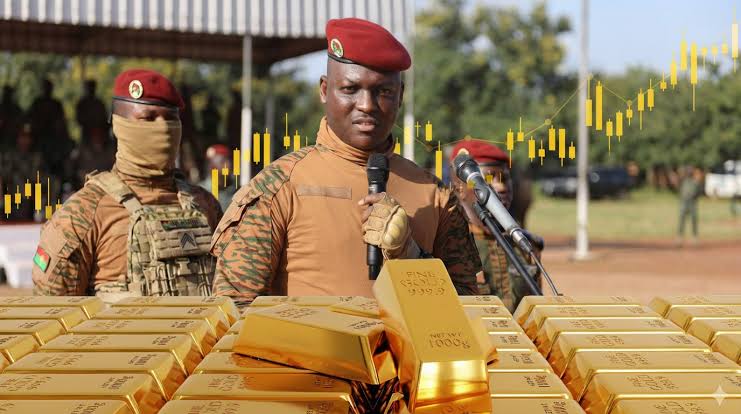
Burkina Faso has opened its first national gold refinery, giving President Ibrahim Traoré’s government a new instrument to tighten control over the country’s biggest mineral export and keep more of the value generated by gold inside the country_.
Traoré inaugurated the National Gold Refinery of Burkina Faso, known as RAFFINOR-BF, in Ouagadougou on Monday, September 28, as his government accelerates efforts to bring more of the mining industry under state control.
The refinery cost over 11 billion CFA francs, about $19 million, and has an initial capacity to process 164 tonnes of gold a year. The government says that capacity could eventually be expanded to 515 tonnes, giving the facility room to handle substantially larger volumes as production grows.
The plant will process gold from industrial and artisanal mining operations and will also provide assaying, certification and secure storage. During the inauguration, officials presented the first gold bar refined entirely in Burkina Faso.
For a country that produced more than 94 tonnes of gold in 2025, the refinery changes where part of that production can be processed before entering international markets. Much of Burkina Faso’s gold has traditionally left the country in doré form for further refining and certification elsewhere, meaning some of the commercial value generated by the mineral was captured outside the country.
Traoré has made changing that arrangement a central part of his economic programme. At the inauguration, he said Burkina Faso no longer wanted to be a country that simply extracted its resources and sent them abroad, and said the government wanted to develop the full mineral value chain domestically.
Gold has become increasingly important to Burkina Faso as the country deals with a prolonged security crisis and seeks new ways to increase state revenue. Mining remains one of the country's most important sources of export earnings, while gold production takes place across a sector that includes large industrial mines and thousands of smaller informal operations.
The government has been trying to bring more of that activity under state supervision. It has increased the role of state-owned mining companies, taken control of some mining assets and introduced tighter measures governing artisanal production and gold exports.
The effort is also aimed at limiting smugglin as authorities have repeatedly warned that gold is leaving Burkina Faso through informal channels, depriving the state of revenue and making it harder to establish how much of the country's production reaches legitimate markets.
The problem is particularly sensitive because gold mining overlaps with the country's security crisis. Large parts of Burkina Faso have been affected by attacks from jihadist groups, while informal mining and cross-border gold trading have complicated efforts to regulate the sector.
The new refinery gives the government greater control over one of the points at which that trade can be monitored. Gold entering the formal system can be weighed, tested, certified and stored domestically before being sold, creating a clearer record of production and potentially increasing the revenue collected by the state.
But the refinery does not by itself resolve the problems surrounding Burkina Faso's gold industry. Its success will depend on whether enough production is channelled through the facility, whether informal miners can be brought into the formal economy and how effectively authorities can prevent gold from continuing to leave through unofficial routes.
Its 164-tonne initial capacity is already larger than Burkina Faso's reported 2025 production, although the government's proposed expansion to 515 tonnes suggests that it sees the refinery as infrastructure for a much larger domestic and potentially regional gold-processing industry.
The move also places Burkina Faso within a wider African push to process more natural resources locally rather than exporting minerals with much of their downstream value still to be created. For Traoré's government, however, the refinery is closely tied to a broader argument about economic sovereignty: extracting the gold is no longer supposed to be the end of the country's role in the business.
The first refinery is now operating in Ouagadougou. The larger test will be whether Burkina Faso can use it to bring more of its gold trade into the formal economy and retain a greater share of the wealth generated by a resource that has become central to its economy.

 Noble Nigeria

© Noble Nigeria. All Rights Reserved || Privacy Policy and User Agreement