
Source: BBC
7.4-Magnitude Earthquake Strikes Colombia: Kills 111, Damages over Than 1,600 Buildings
A powerful earthquake struck western Colombia early Monday, killing at least 111 people and injuring dozens more as emergency crews searched collapsed buildings and authorities began assessing the damage across several cities.
The magnitude 7.4 earthquake struck near San José del Palmar in the department of Chocó, according to the U.S. Geological Survey. The tremor was felt far beyond the immediate area, including in Cali, Pereira and Manizales, and across parts of neighbouring Ecuador and Panama.
The Colombian government declared a national emergency as reports of damage came in from across the region.
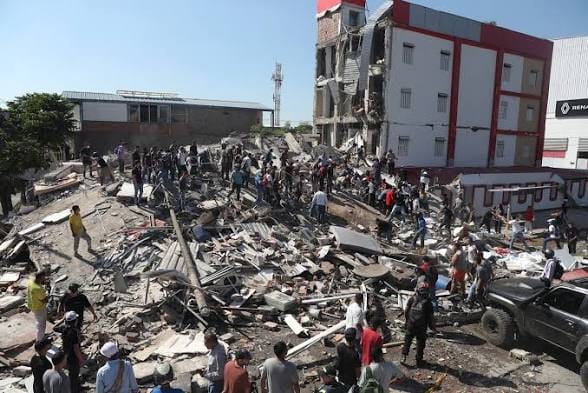
More than 1,600 buildings were damaged and at least 61 collapsed, according to officials. Several roads and public facilities were also affected, while airports in parts of western Colombia were temporarily closed as authorities inspected their runways and buildings.
In Cali, Colombia's third-largest city, rescue teams were deployed to areas where buildings had collapsed and people were believed to be trapped. Residents also joined the search, helping emergency workers clear debris from damaged structures.
The earthquake caused visible damage in some of the country's most recognisable buildings. In Manizales, part of the city's neo-Gothic cathedral was damaged. In Pereira, sections of the airport were affected, while hospitals in Cali evacuated patients as the shaking continued.
The Colombian Geological Service said the earthquake was the strongest recorded in the country this century. At least 21 aftershocks followed the main tremor, adding another layer of difficulty for rescue workers and residents returning to damaged buildings.
The scale of the earthquake is significant even for a country accustomed to seismic activity.
Colombia lies within the Pacific Ring of Fire, the enormous belt of tectonic activity responsible for many of the world's earthquakes and volcanic eruptions. Earthquakes are relatively common across parts of western and central Colombia, but an event of this magnitude is considerably less frequent.
The country's history provides a reminder of what a major earthquake can do.
In 1999, a magnitude 6.2 earthquake struck the city of Armenia in Colombia's coffee-growing region. More than 1,000 people died and thousands of buildings were destroyed or damaged. The disaster transformed earthquake preparedness and construction standards across parts of the country.
A magnitude 7.4 earthquake releases substantially more energy than the smaller tremors that Colombia experiences regularly. Seismologists have also been examining why an earthquake whose epicentre was relatively deep still produced significant damage at the surface.
The USGS placed the earthquake at a depth of roughly 107 kilometres. Earthquakes at that depth can spread their energy across a wider area, meaning communities far from the epicentre can still experience strong shaking.
That helps explain why the effects were felt across several major cities rather than remaining concentrated around Chocó.
Chocó is one of Colombia's most isolated regions. Dense rainforest, rivers and limited road connections make parts of the department difficult to reach even under normal circumstances. San José del Palmar, near the earthquake's epicentre, does not have an airport which could complicate the government's efforts to determine the full extent of the destruction.
The first reports after a major earthquake rarely provide the complete picture. Communications can fail. Roads become impassable. Remote communities may be unable to contact authorities. Buildings that appear intact from the outside may still be structurally unsafe.
For emergency services, the immediate task is therefore not simply counting damaged buildings. It is establishing which communities need help first.
President Abelardo de la Espriella, who had only recently taken office, directed government agencies towards rescue and emergency operations. The government said resources were being moved into affected areas while authorities continue evaluating the damage.
The earthquake has also disrupted ordinary life far beyond the buildings that collapsed.
Airports were temporarily suspended in several cities while inspections were carried out. Residents were forced into streets during the shaking, and hospitals had to move patients away from potentially unsafe structures.
For people living in damaged buildings, the danger does not necessarily disappear when the first earthquake ends. Aftershocks can bring down structures already weakened by the initial tremor, which is why authorities have warned residents against returning to unsafe buildings before inspections are completed.
The question now is how much of the initial damage has been captured in the official figures.
The death toll could change as rescue teams reach more remote areas, particularly around Chocó. Authorities are still working to establish the condition of communities where access and communication remain difficult.
The disaster also raises a broader question for Colombia: how prepared are its cities and infrastructure for earthquakes of this scale?
The country has invested heavily in seismic building standards since previous disasters, particularly after the 1999 Armenia earthquake. But preparedness is not evenly distributed. Modern construction in major cities exists alongside older buildings and communities with fewer resources, while remote areas can face a very different challenge altogether: getting emergency assistance there in the first place.
That distinction matters because earthquake does not have to destroy an entire city to create a national emergency. It only needs to strike where buildings are vulnerable, where roads are difficult to navigate or where emergency services cannot arrive quickly.
In Colombia, Monday's earthquake brought all three problems into focus.
For now, rescue operations remain the priority. Authorities are continuing to search damaged buildings, assess infrastructure and reach communities closest to the epicentre.
The full consequences of the earthquake will become clearer in the days ahead - not only through the number of lives lost and buildings destroyed, but through the work of rebuilding homes, restoring transport links and determining which structures can safely be occupied again.
For a country that has learned repeatedly to live with earthquakes, Monday's disaster is another reminder that seismic risk is not measured only by the strength of the ground beneath a city.
It is also measured by what stands above it.

 Noble Nigeria

© Noble Nigeria. All Rights Reserved || Privacy Policy and User Agreement